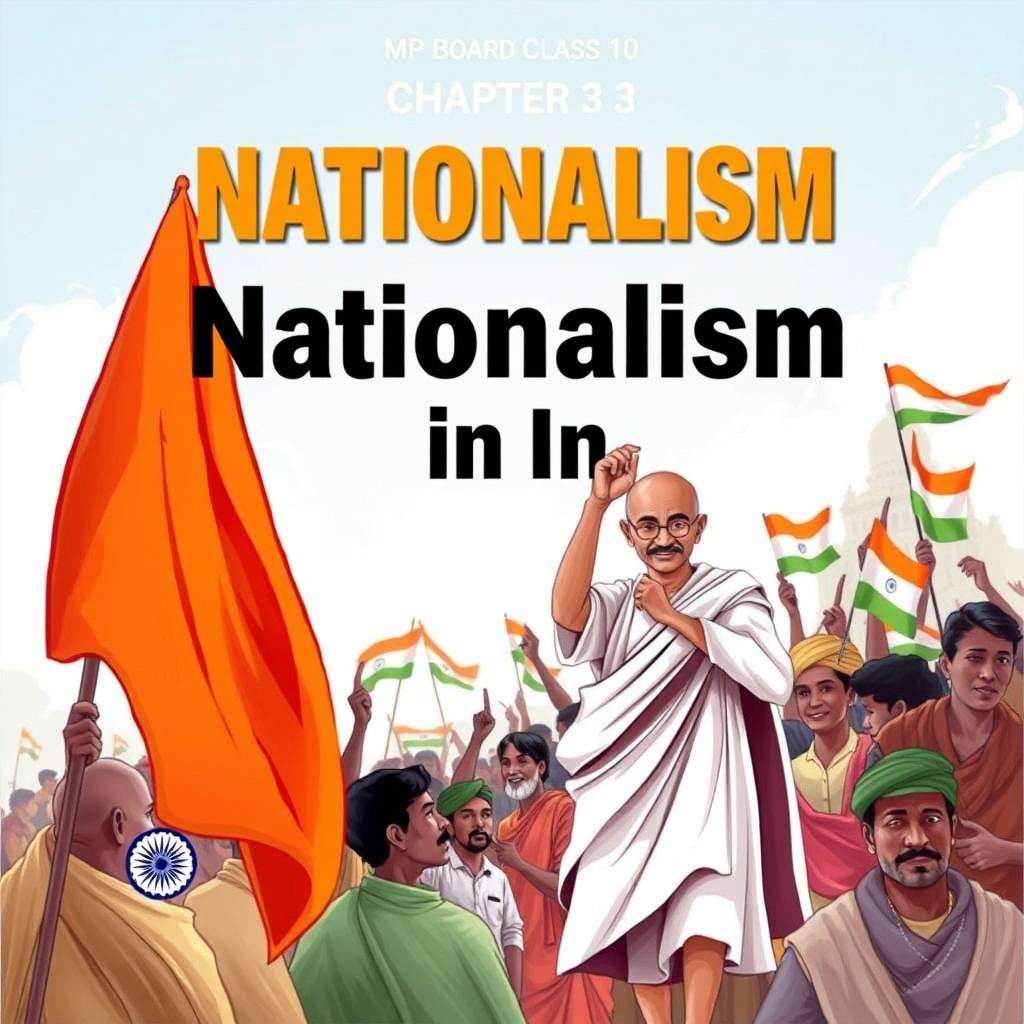
MP Board Class 10 Social Science Chapter 3: राष्ट्रवाद in India (Nationalism in India) — This chapter explores the growth of nationalism in India from the early 20th century through the Civil Disobedience Movement. Students will learn about the First World War’s impact on India, the Non-Cooperation Movement (1920–22), the Dandi March, and how different social groups participated in India’s freedom struggle. This chapter carries significant weightage in the MP Board Class 10 Social Science exam, with 6–10 marks allocated across objective, short, and long answer questions.
🌍 1. Impact of the First World War on India
The First World War (1914–1918) was a turning point in the history of Indian nationalism. Britain dragged India into the war without consulting Indian leaders, and this decision had far-reaching consequences for the freedom movement.
Economic Impact of the War
India’s participation in the war placed an enormous financial burden on the Indian people. The British government imposed heavy taxes, increased customs duties, and introduced income tax to fund the war effort. Over 1.5 million Indian soldiers were recruited and sent to fight in different parts of the world. The prices of essential commodities doubled between 1913 and 1918, causing immense hardship for common people. Families faced severe shortages of food grains, cloth, and kerosene.
Indian businessmen and industrialists, however, made huge profits during the war. They expanded their industries and demanded greater participation in the governance of the country. This growing economic nationalism combined with wartime hardships created conditions conducive to the rise of a mass nationalist movement.
🎯 Exam Tip: The economic impact of WWI is a frequently asked topic in MP Board exams. Remember three key effects: (1) huge increase in taxes, (2) doubling of prices, (3) forced recruitment of soldiers. This question appears as 3-mark or 4-mark questions.
Political Impact of the War
During the war, Mahatma Gandhi returned to India from South Africa (1915). He began experimenting with the technique of satyagraha — mass agitation based on non-violence and truth. He organized successful satyagraha movements in Champaran (Bihar, 1917) to support indigo farmers, in Kheda (Gujarat, 1918) to support peasants affected by crop failure, and in Ahmedabad (1918) for mill workers. These early movements established Gandhiji’s leadership and the effectiveness of non-violent protest in the Indian context.
| Year |
Movement |
Place |
Issue |
| 1917 |
Champaran Satyagraha |
Bihar |
Indigo farmers’ exploitation |
| 1918 |
Kheda Satyagraha |
Gujarat |
Peasants affected by crop failure |
| 1918 |
Ahmedabad Mill Strike |
Ahmedabad |
Mill workers’ wage dispute |
✊ 2. The Non-Cooperation Movement (1920–22)
The Non-Cooperation Movement was the first major mass movement led by Mahatma Gandhi. It was launched in response to the Rowlatt Act, the Jallianwala Bagh massacre, and the failure of British authorities to address Indian grievances after World War I.
Causes of the Non-Cooperation Movement
- Rowlatt Act (1919): The British government passed the Rowlatt Act which gave authorities the power to arrest and imprison anyone without trial. This was seen as a black law against civil liberties.
- Jallianwala Bagh Massacre (April 13, 1919): General Dyer ordered troops to fire on unarmed civilians in Amritsar, killing hundreds. The brutality shocked the entire nation.
- Khilafat Issue: The Ottoman Caliphate was threatened after WWI. Indian Muslims saw this as an attack on their religious leadership. The Khilafat movement led by the Ali brothers (Mohammad Ali and Shaukat Ali) merged with the nationalist movement under Gandhi’s leadership.
- Economic Hardship: Heavy war taxes, rising prices, and unemployment created widespread discontent among all sections of society.
Programme of the Non-Cooperation Movement
Gandhiji proposed a step-by-step programme of non-cooperation:
- Surrender of titles and honorary positions
- Boycott of legislative councils, courts, and government schools
- Boycott of foreign goods and promotion of khadi and Indian handicrafts
- Resignation from government jobs
Withdrawal of the Movement
In February 1922, a violent incident occurred in Chauri Chaura (Gorakhpur district, Uttar Pradesh) where protesters set fire to a police station, killing 22 policemen. Deeply disturbed by this violence, Mahatma Gandhi called off the Non-Cooperation Movement on February 12, 1922. This decision surprised many leaders and disappointed the masses, but Gandhi remained firm on his principle of non-violence.
📘 Key Fact: The Chauri Chaura incident was a turning point. Gandhi’s decision to call off the movement despite its nationwide popularity showed his unwavering commitment to ahimsa (non-violence). This decision led to his arrest in March 1922, and he was sentenced to six years in prison.
⚖️ 3. The Rowlatt Act and Jallianwala Bagh Massacre
The Rowlatt Act (1919)
The Rowlatt Act was passed by the Imperial Legislative Council in March 1919 despite the unanimous opposition of Indian members. It allowed the British government to arrest and detain anyone suspected of sedition for up to two years without trial. Indians could be imprisoned without habeas corpus — the fundamental right to be presented before a court of law. Gandhi called for a nationwide hartal (strike) on April 6, 1919 to protest this oppressive legislation.
Jallianwala Bagh Massacre (April 13, 1919)
On April 13, 1919, thousands of unarmed men, women, and children gathered at Jallianwala Bagh in Amritsar to protest against the arrest of nationalist leaders Dr. Satya Pal and Dr. Saifuddin Kitchlew. The gathering was peaceful, but Brigadier General Reginald Dyer — without any warning — ordered his troops to open fire on the crowd. The firing continued for about ten minutes, killing hundreds (official estimates: 379; Indian estimates: over 1,000). The only exit was a narrow lane, and the army had blocked it.
Rabindranath Tagore renounced his knighthood in protest. The Hunter Commission was formed to investigate the massacre, but General Dyer faced no real punishment — he was merely relieved of his command and retired on full pay. The massacre shattered any remaining faith Indians had in British justice.
🎯 Exam Tip: Jallianwala Bagh is a 3-mark favourite. Remember: Date (April 13, 1919), Location (Amritsar, Punjab), General (Dyer), Casualties (379 official, 1000+ Indian estimate), and Outcome (Tagore returned knighthood, Hunter Commission formed).
📜 4. Simon Commission and Civil Disobedience Movement
The Simon Commission (1928)
The British government appointed the Simon Commission in 1927 to review the working of the Government of India Act of 1919. The commission had seven members, all British — not a single Indian was included. When the commission arrived in Bombay in February 1928, it was greeted with black flags and the slogan “Simon Go Back.” The commission was boycotted across India. In Lahore, Lala Lajpat Rai was severely lathi-charged while protesting, and he succumbed to his injuries a few weeks later.
Nehru Report and Demand for Purna Swaraj
In response to the challenge of the Simon Commission, the Indian National Congress appointed a committee under Motilal Nehru to draft a constitution for India. The Nehru Report (August 1928) demanded Dominion Status for India. However, the British government ignored this demand. At the Lahore Session of the Congress in December 1929, under the presidency of Jawaharlal Nehru, the historic resolution of Purna Swaraj (complete independence) was passed. It was decided that January 26, 1930 would be celebrated as the first Independence Day.
The Civil Disobedience Movement (1930–34)
The Civil Disobedience Movement began with Mahatma Gandhi’s famous Dandi March (March 12 – April 6, 1930). Gandhi, along with 78 followers, walked 240 miles from Sabarmati Ashram to Dandi, a coastal village in Gujarat, to break the British salt laws by making salt from seawater. This was a powerful symbolic act because salt was a commodity used by every Indian, regardless of class or religion, and the salt tax affected everyone equally.
The movement spread rapidly across the country. People refused to pay taxes, boycotted foreign cloth and liquor, and violated forest laws. The government responded with mass arrests. Gandhi was arrested in May 1930. By the end of 1930, over 60,000 people had been imprisoned.
Eventually, the Gandhi-Irwin Pact was signed in March 1931, and Gandhi agreed to attend the Second Round Table Conference in London. However, the conference failed to reach an agreement on minority rights, and the struggle resumed.
| Event |
Date |
Key Figure |
Significance |
| Simon Commission arrives |
Feb 1928 |
Lala Lajpat Rai |
Boycotted nationwide |
| Nehru Report |
Aug 1928 |
Motilal Nehru |
Demanded Dominion Status |
| Purna Swaraj resolution |
Dec 1929 |
Jawaharlal Nehru |
Complete independence demand |
| Dandi March begins |
Mar 12, 1930 |
Mahatma Gandhi |
Salt Satyagraha |
| Gandhi-Irwin Pact |
Mar 1931 |
Gandhi + Lord Irwin |
Truce, Round Table attend |
👥 5. How Different Groups Participated in the Movement
The Middle Class Participation
Lawyers gave up their practices, students left government schools, and teachers resigned from their posts. The boycott of foreign cloth led to a sharp decline in British textile imports. Thousands of young men and women joined the movement. Outside the Congress, organizations like the Hindustan Socialist Republican Association (HSRA) led by Bhagat Singh, Sukhdev, and Rajguru took more militant approaches, including the bombing of the Central Legislative Assembly in 1929.
The Peasant Movement
Peasants were the largest section of participants in the nationalist movement. In Awadh (present-day Uttar Pradesh), Baba Ramchandra led a peasant movement against talukdars and landlords who demanded exorbitant rents and forced unpaid labour (begar). The peasants demanded reduction of revenue, abolition of begar, and social boycott of oppressive landlords. By October 1921, the Oudh Kisan Sabha was established with Jawaharlal Nehru as its president.
The Tribal Movement
In the forests of the Central Provinces (Madhya Pradesh), tribal communities like the Bhils, Gonds, and Baigas participated actively. The colonial government had imposed forest laws that restricted their traditional rights to collect forest produce and practice shifting cultivation. In Andhra Pradesh, the Alluri Sitarama Raju led the Rampa Rebellion (1922–24) where tribal people fought against the British forest laws. Raju claimed divine powers and became a folk hero.
The Role of Women
Women participated in large numbers for the first time during the Civil Disobedience Movement. Thousands of women came out of their homes to join protest marches, picket liquor and foreign cloth shops, and court arrest. Prominent women leaders included Kamaladevi Chattopadhyay, Sarojini Naidu, Mithuben Petit, and Kasturba Gandhi. Gandhi had encouraged women to participate actively, and their involvement was a significant step in breaking traditional social barriers.
| Social Group |
Type of Participation |
Key Leaders |
| Industrial workers |
Strikes, boycotts |
– |
| Peasants |
No-tax campaigns |
Baba Ramchandra, J.L. Nehru |
| Tribal communities |
Armed rebellion |
Alluri Sitarama Raju |
| Women |
Protest marches, picketing |
Sarojini Naidu, Kamaladevi |
| Business class |
Financial support, swadeshi |
G.D. Birla, Purshottamdas Thakurdas |
🇮🇳 6. The Sense of Collective Belonging
Nationalism is not just a political movement — it is also a cultural phenomenon. The feeling of belonging to one nation was created through various means:
Symbols and Songs
Bankim Chandra Chattopadhyay’s ‘Vande Mataram’ became a rallying cry for the national movement. The tricolour flag was designed by Pingali Venkayya in 1921 and was adopted in different forms. Rabindranath Tagore’s ‘Jana Gana Mana’ was another powerful expression of nationalist feeling. The image of Bharat Mata was popularized through paintings by Abanindranath Tagore.
Reinterpretation of History
Nationalist leaders and writers began reinterpreting Indian history to create pride in the ancient past. They highlighted India’s achievements in science, mathematics, philosophy, art, and governance before British rule. This created a sense of shared heritage and inspired people to work towards a free and glorious future.
The Role of Folklore and Print Media
Nationalist newspapers, pamphlets, and books spread the message of nationalism across India. Folk tales, songs, and theatre performances carried nationalist ideas to the masses. In Bengal, the nationalist theatre became highly popular. Writers like Subramania Bharati in Tamil Nadu and Muhammad Iqbal in Urdu poetry inspired millions with their nationalist verses.
📘 Key Fact: The national flag was first designed by Pingali Venkayya in 1921. The original flag had green, yellow, and red bands with a charkha (spinning wheel) in the middle. The current tricolour (saffron, white, green) with Ashoka Chakra was adopted by the Constituent Assembly on July 22, 1947.
📅 7. Important Dates and Timeline
| Year |
Event |
Significance |
| 1915 |
Gandhi returns to India |
From South Africa |
| 1917 |
Champaran Satyagraha |
Indigo farmers’ struggle |
| 1919 |
Rowlatt Act + Jallianwala Bagh |
Turning point in freedom struggle |
| 1920–22 |
Non-Cooperation Movement |
First mass movement under Gandhi |
| 1922 |
Chauri Chaura incident |
Movement withdrawn |
| 1928 |
Simon Commission |
Boycotted, Lajpat Rai martyred |
| 1929 |
Lahore Session |
Purna Swaraj declared |
| 1930 |
Dandi March |
Salt Satyagraha begins |
| 1931 |
Gandhi-Irwin Pact |
Temporary truce |
📋 Previous Year Questions (2017–2026)
| Year |
Question |
Marks |
| 2025 |
Why did Mahatma Gandhi call off the Non-Cooperation Movement? |
3 |
| 2024 |
Explain the impact of the First World War on the growth of nationalism in India. |
5 |
| 2024 |
What was the Rowlatt Act? Why was it opposed by Indians? |
3 |
| 2023 |
Describe the Dandi March. What was its significance in the freedom struggle? |
5 |
| 2023 |
What happened at Jallianwala Bagh on April 13, 1919? |
3 |
| 2022 |
Why did merchants and industrialists support the Civil Disobedience Movement? |
4 |
| 2022 |
What was the Simon Commission? Why was it boycotted? |
3 |
| 2021 |
Explain the role of peasants in the Non-Cooperation Movement. |
4 |
| 2020 |
How did the sense of collective belonging develop among Indians during the nationalist movement? |
5 |
| 2019 |
Describe the different social groups that participated in the Civil Disobedience Movement. |
5 |
❓ Frequently Asked Questions
Q: What is the difference between Non-Cooperation and Civil Disobedience Movement?
The Non-Cooperation Movement (1920–22) involved refusing to cooperate with British institutions — surrendering titles, boycotting courts and schools, and rejecting government jobs. The Civil Disobedience Movement (1930–34) went further by actively breaking specific British laws — the salt laws, forest laws, and tax regulations. Civil Disobedience was more confrontational as it involved violating unjust laws rather than merely withdrawing cooperation.
Q: Why did Gandhi choose salt as the symbol for the Civil Disobedience Movement?
Salt was a universal commodity used by every Indian, rich or poor. The salt tax was regressive and affected all sections of society equally. By breaking the salt laws, Gandhi made the freedom struggle accessible to the common person. The choice was brilliant because it was a simple, non-violent, and highly symbolic act that every Indian could understand and participate in.
Q: What was the Khilafat Movement and why did Gandhi support it?
The Khilafat Movement (1919–22) was launched by Indian Muslims to protect the Ottoman Caliphate (Khilafat) after World War I. Gandhi saw this as an opportunity to unite Hindus and Muslims against British rule. He supported the Khilafat cause and linked it to the Non-Cooperation Movement, creating a united anti-British front. This Hindu-Muslim unity was unprecedented in the history of the freedom struggle.
Q: What was the significance of the Lahore Session of Congress (1929)?
The Lahore Session of the Indian National Congress in December 1929, under the presidency of Jawaharlal Nehru, passed the historic Purna Swaraj resolution declaring complete independence as the goal of the Congress. It also decided to launch the Civil Disobedience Movement and announced that January 26, 1930 would be celebrated as the first Independence Day across India. This session marked a decisive shift from Dominion Status to complete independence.
Q: How did Indian business classes support the nationalist movement?
Indian business classes supported the movement financially, promoted swadeshi goods, and participated in the boycott of foreign textiles. They provided funding for Congress activities, sponsored nationalist newspapers, and established indigenous industries. However, their support was conditional — they were primarily interested in breaking British trade monopolies and gaining economic advantages. Some industrialists like G.D. Birla and Purshottamdas Thakurdas played important roles behind the scenes.
Q: Explain the role of tribal communities in India’s freedom struggle.
Tribal communities participated actively in the freedom struggle, though their motivations were often local. The Rampa Rebellion in Andhra Pradesh led by Alluri Sitarama Raju (1922–24) is the most famous example. Tribal communities in the forest regions of Madhya Pradesh, Chhattisgarh, and Jharkhand also participated in the national movement. Their grievances were related to forest laws that restricted their traditional rights. While their struggles were rooted in local issues, they became part of the broader nationalist narrative.
Q: What was the Gandhi-Irwin Pact?
The Gandhi-Irwin Pact was signed in March 1931 between Mahatma Gandhi and Lord Irwin, the British Viceroy of India. According to the pact, the British government agreed to release all political prisoners (except those convicted for violence), allow the free collection of salt by people living near coastal areas, and permit peaceful picketing of liquor and foreign cloth shops. In return, Gandhi agreed to suspend the Civil Disobedience Movement and attend the Second Round Table Conference in London to discuss constitutional reforms.
Q: How did women contribute to the Indian freedom struggle?
Women contributed significantly during the Civil Disobedience Movement. Thousands of women from urban and rural areas participated in protest marches, picketed foreign cloth and liquor shops, and faced lathi-charges and imprisonment. Sarojini Naidu led women’s processions and negotiated with British authorities. Kasturba Gandhi, Kamaladevi Chattopadhyay, and Mithuben Petit were prominent participants. Gandhi’s call to women to join the struggle gave them a new sense of confidence and marked their entry into public political life on a large scale.
Q: What is the importance of the Chauri Chaura incident?
The Chauri Chaura incident (February 4, 1922) was a violent clash between protesters and police in Gorakhpur, Uttar Pradesh, where 22 policemen were killed when protesters set fire to the police station. Gandhi immediately called off the Non-Cooperation Movement, which shocked many nationalist leaders. The incident demonstrated Gandhi’s firm commitment to non-violence even at the cost of a popular movement. It also led to Gandhi’s arrest and a period of intense government repression against nationalists.
Q: How did the First World War create conditions for nationalism in India?
The First World War created several conditions that fueled nationalism: (1) Economic hardship through increased taxes and rising prices; (2) Forced recruitment of Indian soldiers creating resentment; (3) Growth of Indian industries that produced a new business class demanding political rights; (4) Exposure of Indian soldiers to global ideas of democracy and self-determination; (5) The British betrayal of wartime promises of constitutional reforms. Together, these factors transformed the nationalist movement from a limited elite affair into a mass struggle.