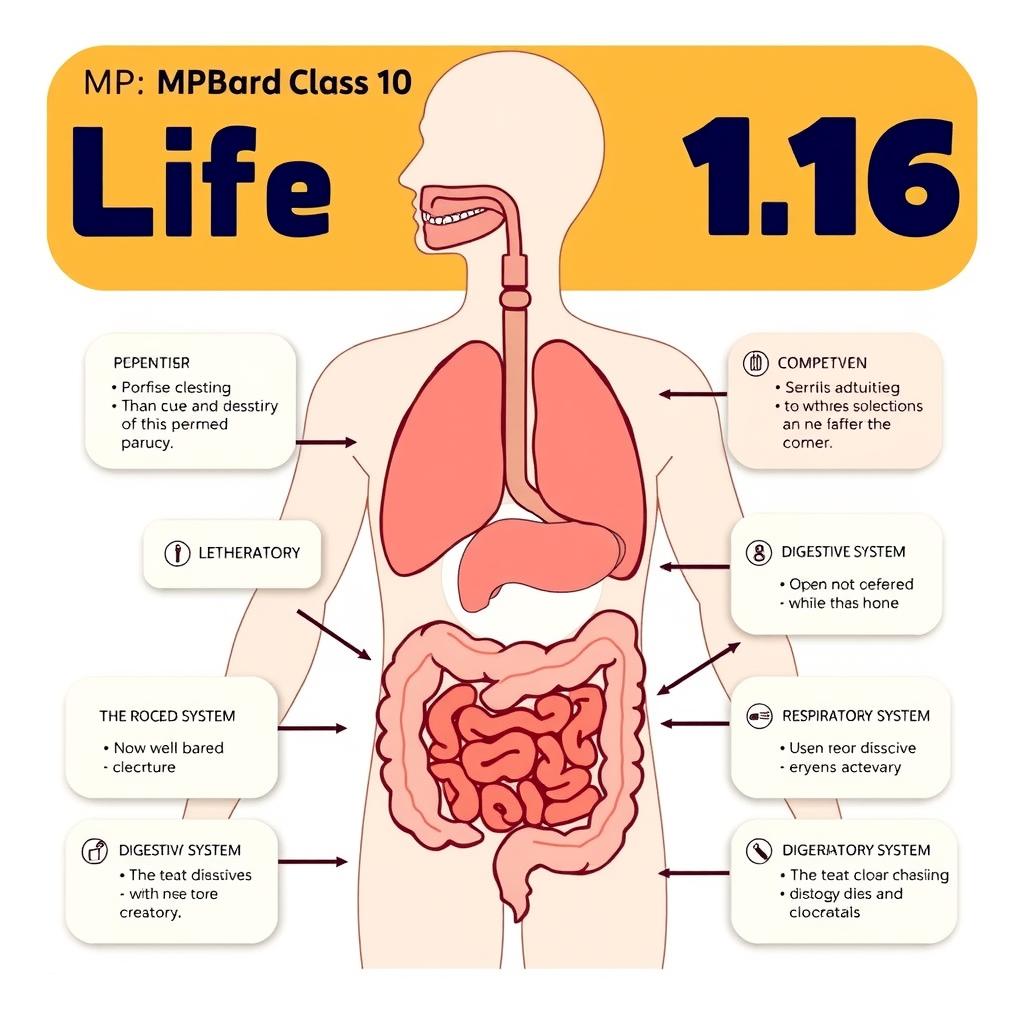
MP Board Class 10 Science Chapter 5: Life Processes Notes…
MP Board Class 10 Science Chapter 5: Life Processes (जैव प्रक्रम) — This chapter explains the essential life processes that keep living organisms alive — nutrition, respiration, transportation, and excretion. Carrying 8–12 marks in the MP Board Class 10 Science exam, Life Processes is one of the most important biology chapters. This guide covers the human digestive system, respiratory system, circulatory system, and excretory system with detailed diagrams, processes, and previous year questions.
📑 Table of Contents
🧬 1. What Are Life Processes?
Living organisms perform certain basic functions that are essential for survival. These functions are called life processes. They include:
- Nutrition — Obtaining food and converting it into energy
- Respiration — Breakdown of food to release energy
- Transportation — Movement of substances within the body
- Excretion — Removal of waste products
- Growth, Movement, Reproduction — Other life processes
🌿 2. Nutrition — Autotrophic and Heterotrophic
Autotrophic Nutrition (Photosynthesis)
Plants make their own food through photosynthesis. The process uses sunlight, carbon dioxide, and water to produce glucose and oxygen.
Heterotrophic Nutrition
Organisms that cannot make their own food depend on others. Types:
- Holozoic Nutrition — Ingestion of solid food. Steps: Ingestion → Digestion → Absorption → Assimilation → Egestion
- Parasitic Nutrition — Living on or inside a host (tapeworm, Cuscuta)
- Saprotrophic Nutrition — Feeding on dead matter (fungi, bacteria)
🍽️ 3. Human Digestive System
Organs of the Digestive System
The human digestive system consists of the alimentary canal and digestive glands.
Digestive Glands
- Salivary Glands — Produce saliva with salivary amylase
- Liver — Largest gland, secretes bile that emulsifies fats
- Pancreas — Produces trypsin, lipase, and amylase
📘 Key Fact: The small intestine has millions of finger-like villi that increase surface area for absorption.
🫁 4. Respiration — Aerobic and Anaerobic
Respiration is the process of releasing energy from food. It can be aerobic (with oxygen) or anaerobic (without oxygen).
Aerobic: C₆H₁₂O₆ + 6O₂ → 6CO₂ + 6H₂O + Energy
Anaerobic (yeast): C₆H₁₂O₆ → 2C₂H₅OH + 2CO₂ + Energy
Anaerobic (muscles): C₆H₁₂O₆ → 2C₃H₆O₃ + Energy
Human Respiratory System
- Nostrils — Filter air with hair and mucus
- Nasal Cavity — Warms and moistens air
- Pharynx → Larynx → Trachea — Air passage
- Bronchi → Bronchioles → Alveoli — Site of gas exchange
🫀 5. Transportation in Human Beings
The Circulatory System
The human circulatory system consists of heart, blood vessels, and blood. It is a double circulatory system.
📘 Key Fact: The human heart is four-chambered (2 atria + 2 ventricles). The left side pumps oxygenated blood, the right side pumps deoxygenated blood — preventing mixing.
Blood Vessels
Lymphatic System
Lymph is a colourless fluid that drains excess fluid from tissues into the blood. Lymph nodes contain WBCs that fight infections.
🧪 6. Excretion in Human Beings
Excretion is the removal of metabolic waste products. The main excretory organs are kidneys.
The Human Excretory System
- Kidneys — Filter blood, produce urine
- Ureters — Carry urine to urinary bladder
- Urinary Bladder — Stores urine temporarily
- Urethra — Passage for urine to exit
Nephron — Functional Unit of Kidney
Each kidney has about 1 million nephrons. Each nephron consists of:
- Glomerulus — Tuft of capillaries, blood filtration
- Bowman’s Capsule — Cup-shaped structure around glomerulus
- PCT — Reabsorption of water, glucose, amino acids
- Loop of Henle — Water & salt reabsorption
- DCT — Selective reabsorption of ions
- Collecting Duct — Collects urine, carries to ureter
🌱 7. Transportation in Plants
Xylem and Phloem
Transpiration
Transpiration is the loss of water vapour from leaves through stomata. It creates transpiration pull that moves water upward through xylem.
📋 Previous Year Questions (2017–2026)
📝 Practice Questions for 2027 Exam
Q1: List the five steps of holozoic nutrition in correct order.
Answer: Ingestion → Digestion → Absorption → Assimilation → Egestion
Q2: Why is the small intestine long? How are its walls adapted for absorption?
Answer: The small intestine (6-7m long) allows maximum time for digestion. Its walls have villi (finger-like projections) that increase surface area for absorption into blood capillaries.
Q3: What causes muscle cramps after heavy exercise?
Answer: During heavy exercise, muscles lack oxygen and perform anaerobic respiration, producing lactic acid. Its accumulation causes cramps.
Q4: Explain double circulation in human beings.
Answer: Blood passes through the heart twice per cycle. Pulmonary circulation: heart → lungs → heart. Systemic circulation: heart → body → heart. This prevents mixing of oxygenated and deoxygenated blood for efficient oxygen delivery.
Q5: Role of: (a) Haemoglobin (b) Lymph (c) Platelets
Answer: (a) Haemoglobin binds oxygen in RBCs and carries it to body cells. (b) Lymph drains excess tissue fluid, transports fats, fights infections. (c) Platelets release clotting factors to form a clot and stop bleeding.