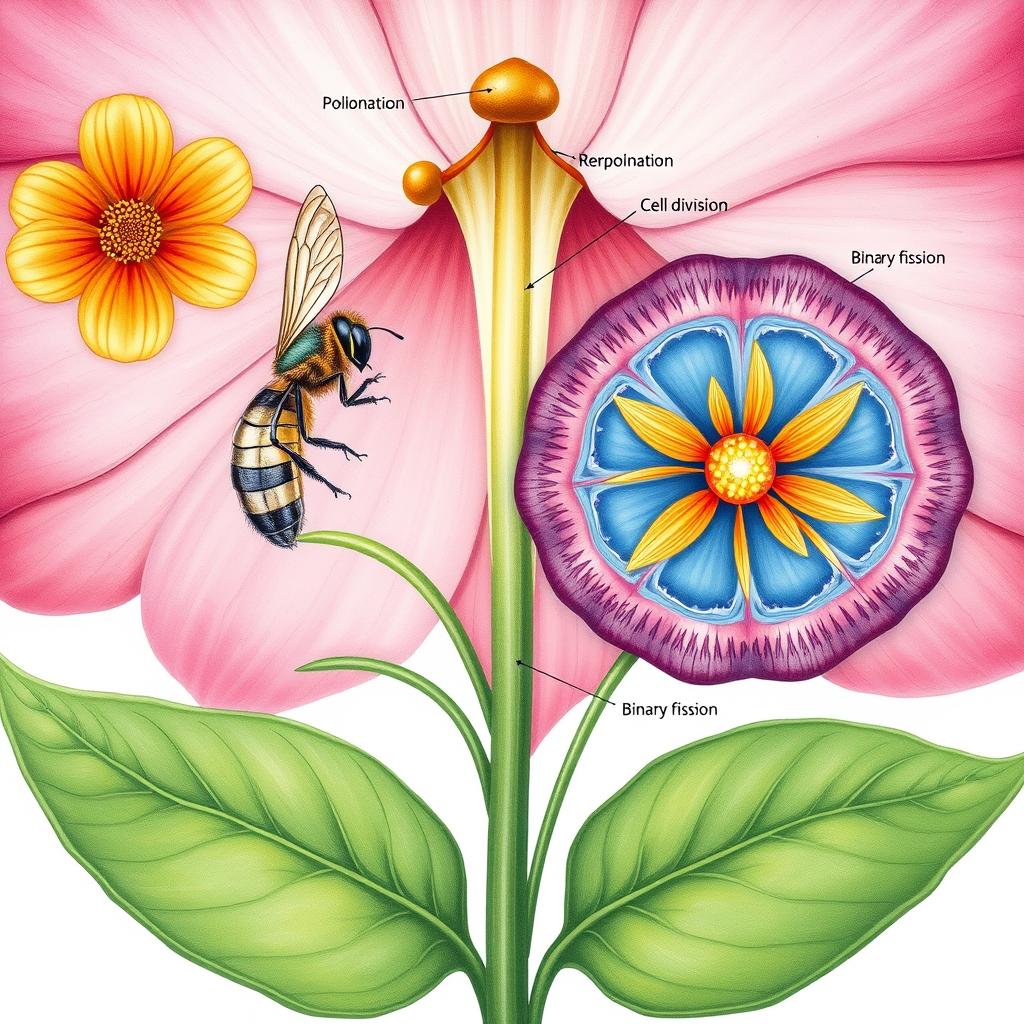
MP Board Class 10 Science Chapter 7: How do Organisms Rep…
Class 10 Science Chapter 7: How do Organisms Reproduce — This chapter explores the fascinating world of reproduction in living organisms. From the simplest binary fission in bacteria to the complex reproductive systems in flowering plants and humans, you’ll learn how life continues across generations. This chapter carries 8-10 marks in the MP Board Class 10 Science exam, with frequent questions on reproduction modes, flower structure, human reproductive system, and contraception methods.
📑 Table of Contents
🔬 1. Reproduction — Introduction and Types
Reproduction is the biological process by which new individual organisms (offspring) are produced from their parents. It is a fundamental feature of all known life. Without reproduction, species would become extinct. Reproduction ensures the continuity of life from one generation to the next.
Why is Reproduction Important?
- Ensures continuity of species from generation to generation
- Introduces genetic variation, which is essential for evolution
- Helps in maintaining the population of a species
- Repairs and replaces damaged or dead cells through cell division
Two Main Types of Reproduction
🧬 2. Asexual Reproduction — Modes and Examples
Asexual reproduction involves only one parent. The offspring are genetically identical to the parent (clones). Various organisms use different modes of asexual reproduction:
Fission (Binary and Multiple)
- Binary fission: Parent cell divides into two equal daughter cells (e.g., Amoeba, Bacteria, Paramoecium)
- Multiple fission: Parent cell divides into many daughter cells simultaneously (e.g., Plasmodium, Malarial parasite)
- In Amoeba, binary fission occurs through irregular division — the nucleus divides first, followed by cytoplasm
Budding
- A small outgrowth (bud) develops on the parent body
- The bud grows, develops into a new individual, and detaches
- Examples: Hydra, Yeast (Saccharomyces cerevisiae)
- In Hydra, the bud contains an outgrowth of the body wall with a tiny mouth and tentacles
Regeneration
- Ability of an organism to grow lost or damaged body parts
- Some organisms can regenerate entire new individuals from fragments
- Examples: Planaria (flatworm), Hydra, Starfish, Lizard (tail regeneration)
- Planaria can be cut into many pieces — each piece can develop into a complete organism
📘 Key Fact: Regeneration is NOT the same as reproduction in higher organisms. Humans can regenerate liver tissue and skin but cannot grow a new individual from a fragment — specialised cells in our body cannot dedifferentiate to form all cell types.
Fragmentation
- The parent body breaks into two or more fragments, each growing into a new individual
- Example: Spirogyra (filamentous algae), some sea anemones
- In Spirogyra, the filament breaks into smaller pieces, each piece grows into a new filament
Spore Formation
- Special reproductive structures called sporangia produce tiny spores
- Each spore germinates to form a new individual under favourable conditions
- Examples: Rhizopus (bread mould), Mosses, Ferns, Mushrooms
- Spores are covered by a thick protective wall to survive unfavourable conditions
Vegetative Propagation
- New plants grow from vegetative parts (root, stem, leaf) of a parent plant
- Common methods: Stems (potato tubers, ginger rhizomes, onion bulbs, grass runners), Roots (sweet potato, dahlia), Leaves (Bryophyllum — leaf buds along margin)
- Artificial methods: Cutting (rose, sugarcane), Layering (jasmine), Grafting (mango, apple)
🌸 3. Sexual Reproduction in Flowering Plants
Flowering plants (angiosperms) reproduce sexually using flowers as their reproductive organs. The flower contains both male and female reproductive parts, enabling fertilisation and seed formation.
Structure of a Flower
- Male part — Stamen: Consists of anther (produces pollen grains) and filament
- Female part — Pistil/Carpel: Consists of stigma (receives pollen), style (tube connecting stigma to ovary), and ovary (contains ovules)
- Accessory parts: Petals (attract pollinators), Sepals (protect the bud), Nectaries (produce nectar)
Pollination
- Definition: Transfer of pollen grains from anther to stigma of a flower
- Self-pollination: Pollen from same flower or same plant (e.g., Pea, Wheat)
- Cross-pollination: Pollen from a different plant of the same species (e.g., Apple, Rose)
- Agents of pollination: Wind (anemophily — grass, maize), Insects (entomophily — sunflower, rose), Birds (ornithophily), Water (hydrophily — Hydrilla)
Fertilisation in Plants
- After pollination, pollen grain germinates on stigma to form a pollen tube
- Pollen tube grows down through style to reach the ovule in ovary
- Male gamete fuses with female gamete (egg) → Zygote → Embryo
- The ovule develops into a seed and the ovary develops into a fruit
- Double fertilisation in angiosperms: One male gamete fuses with egg (forms zygote, 2n), the other fuses with polar nuclei (forms endosperm, 3n for nutrition)
🧍 4. Human Reproductive System
Male Reproductive System
- Testes (अंडकोष): Produce sperm and male hormone testosterone. Located outside abdominal cavity in scrotum — keeps temperature 2–3°C lower than body, needed for sperm production
- Epididymis: Stores and matures sperm
- Vas deferens (शुक्रवाहिका): Transports sperm from epididymis to urethra
- Seminal vesicles and Prostate gland: Add fluid to sperm → forms semen (nutritive medium for sperm)
- Penis: Delivers semen into female reproductive tract
- Urethra: Common passage for both urine and semen
Female Reproductive System
- Ovaries (अंडाशय): Pair of organs producing ova (eggs) and female hormones (oestrogen, progesterone)
- Oviduct / Fallopian tube (डिंबवाहिनी): Site of fertilisation. Transports egg from ovary to uterus. Has finger-like projections (fimbriae) at the end near the ovary
- Uterus (गर्भाशय): Pear-shaped muscular organ where the embryo develops. Inner lining is the endometrium
- Cervix: Lower narrow part of uterus that opens into vagina
- Vagina: Birth canal and receives semen during copulation
🧪 5. Fertilisation, Implantation and Gestation
Fertilisation
- Fusion of male gamete (sperm) with female gamete (egg/ovum) → Zygote
- Occurs in the fallopian tube (ampulla region)
- Only one sperm fertilises the egg — after entry, the egg’s membrane changes to block additional sperm
- The zygote (2n = 46 chromosomes in humans) is the first cell of the new individual
Implantation and Embryo Development
- The zygote undergoes mitotic division as it travels down the fallopian tube towards the uterus
- After about 7 days, it forms a ball of cells (blastocyst) and implants in the uterine wall (endometrium)
- Embryo (first 8 weeks): Major organs and systems develop. Foetus (from week 9): Further growth and maturation
- Placenta: Disc-like structure attached to the uterine wall, connected to foetus by umbilical cord. Provides oxygen and nutrients, removes waste, produces hormones (HCG) to maintain pregnancy
- Gestation period: Approximately 9 months (280 days) in humans
📘 Key Fact: The placenta acts as an endocrine gland — it secretes hormones like hCG (human chorionic gonadotropin), oestrogen, and progesterone to maintain pregnancy. Detection of hCG in urine is the basis of pregnancy tests.
🩺 6. Reproductive Health and Contraception
Puberty and Adolescence
- Puberty: Age (10-14 years for girls, 12-16 years for boys) when reproductive organs become functional
- Release of sex hormones: Testosterone (males), Oestrogen and Progesterone (females)
- Secondary sexual characteristics: Voice change, body hair growth, breast development
- Menstrual cycle (मासिक चक्र): ~28 days cycle in females. Menstruation (days 1-5) → Follicular phase → Ovulation (day 14) → Luteal phase → Next menstruation
Contraception Methods — Comparison Table
Sexually Transmitted Infections (STIs)
- Infections transmitted through sexual contact with an infected person
- Bacterial STIs: Gonorrhoea (Neisseria gonorrhoeae), Syphilis (Treponema pallidum) — can be cured with antibiotics
- Viral STIs: HIV/AIDS (Human Immunodeficiency Virus), Genital herpes, Hepatitis B — can be managed but not cured
- Prevention: Use of condoms, avoiding multiple sexual partners, regular health check-ups
- HIV attacks the immune system (specifically CD4+ T cells), leading to AIDS