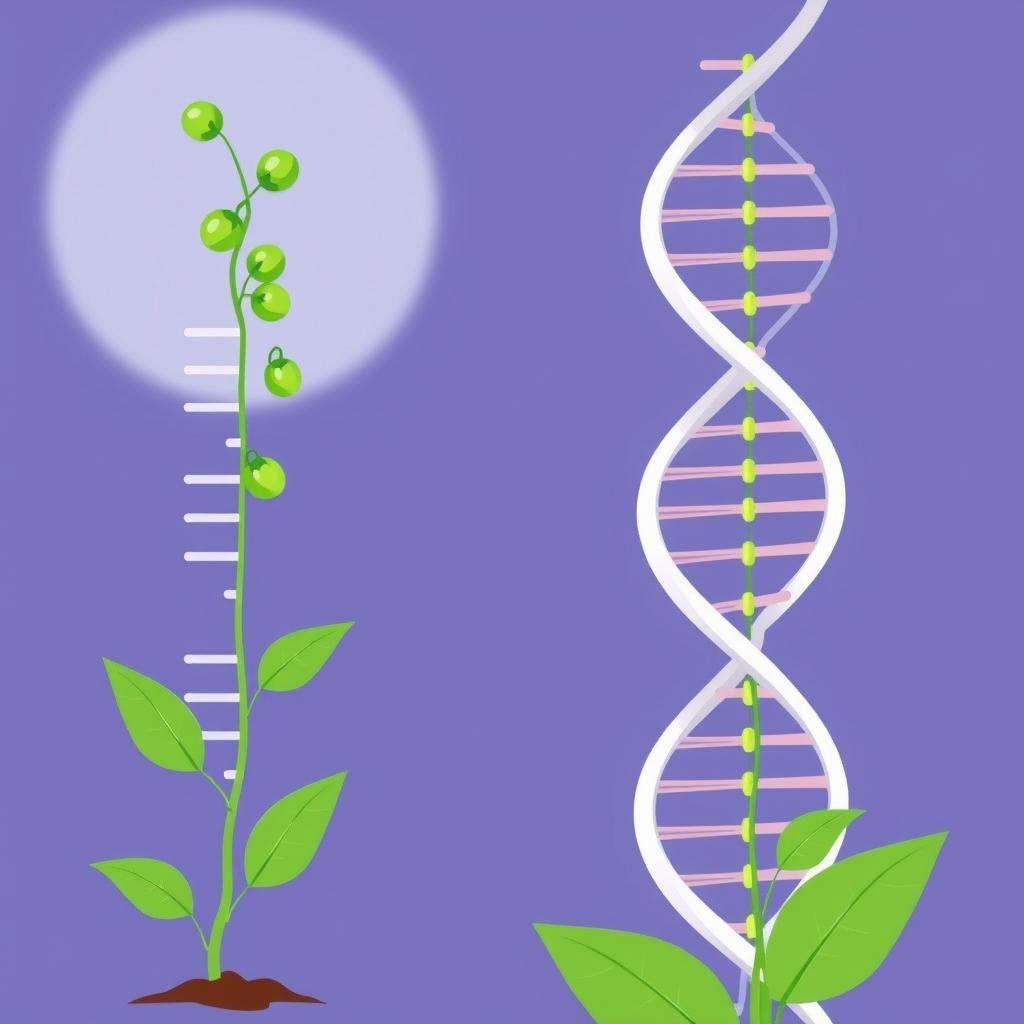
MP Board Class 10 Science Chapter 8: Heredity (आनुवंशिकता…
MP Board Class 10 Science Chapter 8: Heredity (आनुवंशिकता) — This chapter explores the fascinating world of inheritance — how traits are passed from parents to offspring. From Mendel’s pea plant experiments to the discovery of genes and DNA, Chapter 8 covers the fundamental principles of genetics. In MP Board exams, this chapter carries 6–8 marks across short-answer, long-answer, and diagram-based questions. Topics include Mendel’s laws, monohybrid and dihybrid crosses, sex determination, and evolution basics.
📑 Table of Contents
🧬 1. Introduction to Heredity
Heredity is the process by which characteristics (traits) are transmitted from parents to their offspring. Every organism inherits a set of features from its parents — eye color, hair type, height, and even susceptibility to certain diseases. The science of heredity is called Genetics, a term introduced by William Bateson in 1905.
📘 Key Fact: The word “Genetics” comes from the Greek word “genesis” meaning “origin.” Gregor Mendel is known as the Father of Genetics for his pioneering work on pea plants (1856–1863).
1.1 Variation — The Basis of Heredity
No two individuals are exactly alike — even identical twins show subtle differences. This is called variation. Variations arise during reproduction and are essential for evolution. There are two types:
- Acquired Traits — Developed during an organism’s lifetime (e.g., muscle build, scars, language). These are NOT passed to offspring.
- Inherited Traits — Present from birth and passed through genes (e.g., eye color, blood group, skin tone). These ARE passed to offspring.
1.2 Important Terminology
🌱 2. Mendel’s Experiments and Laws of Inheritance
Gregor Mendel (1822–1884), an Austrian monk, conducted experiments on garden pea plants (Pisum sativum) for seven years. He chose pea plants because they had easily observable contrasting traits, could be self-pollinated or cross-pollinated, and had a short generation time.
2.1 Traits Studied by Mendel
2.2 Mendel’s Three Laws
- Law of Dominance: In a heterozygous condition, one allele (dominant) masks the expression of the other (recessive). For example, in Tt plants, only tallness is expressed.
- Law of Segregation: During gamete formation, the two alleles for a trait separate (segregate) so that each gamete carries only one allele. This ensures that offspring get one allele from each parent.
- Law of Independent Assortment: When two or more pairs of traits are considered, the alleles of one trait segregate independently of the alleles of another trait during gamete formation.
🧪 3. Monohybrid Cross
A monohybrid cross involves the inheritance of a single pair of contrasting traits. Mendel’s classic experiment: crossing a pure tall (TT) plant with a pure short (tt) plant.
3.1 Monohybrid Cross — Tall × Short
Parental Generation (P): TT (Tall) × tt (Short)
- Gametes: T from one parent, t from the other
- F1 Generation: All Tt (Tall) — All heterozygous tall plants
- F2 Generation (self-pollination of F1): TT, Tt, Tt, tt
- Phenotypic Ratio (F2): 3 Tall : 1 Short
- Genotypic Ratio (F2): 1 TT : 2 Tt : 1 tt
3.2 Punnett Square for Monohybrid Cross
🔬 4. Dihybrid Cross
A dihybrid cross considers the inheritance of two pairs of contrasting traits simultaneously. Mendel crossed pea plants differing in seed shape (Round vs Wrinkled) and seed color (Yellow vs Green).
4.1 Dihybrid Cross — Round Yellow × Wrinkled Green
Parental Generation (P): RRYY (Round Yellow) × rryy (Wrinkled Green)
- F1 Generation: All RrYy (Round Yellow) — All hybrids
- Gametes from F1: RY, Ry, rY, ry (4 types)
- F2 Phenotypic Ratio: 9 Round Yellow : 3 Round Green : 3 Wrinkled Yellow : 1 Wrinkled Green
- Total combinations: 16 possible zygotes
4.2 Comparison: Monohybrid vs Dihybrid Cross
👫 5. Sex Determination in Humans
In humans, sex is determined by sex chromosomes. Humans have 23 pairs of chromosomes — 22 pairs of autosomes and 1 pair of sex chromosomes. Females have two X chromosomes (XX), while males have one X and one Y chromosome (XY).
5.1 Mechanism of Sex Determination
- Females (XX): Produce only one type of egg — all with X chromosome
- Males (XY): Produce two types of sperm — half with X and half with Y chromosome
- If X sperm fertilizes X egg → Girl (XX)
- If Y sperm fertilizes X egg → Boy (XY)
The probability of having a boy or girl is always 50:50. The father’s sperm determines the sex of the child — not the mother.
5.2 Sex Determination in Other Organisms
- Birds: ZZ (male) — ZW (female) — opposite of humans
- Some insects (grasshoppers): XX (female) — XO (male, no Y chromosome)
- Honeybees: Females are diploid (from fertilized eggs), males (drones) are haploid (from unfertilized eggs)
🦕 6. Evolution — Basic Concepts
Evolution is the gradual change in the characteristics of a population over generations. It explains how simple life forms gave rise to complex organisms over millions of years.
6.1 Charles Darwin’s Theory of Natural Selection
Charles Darwin (1809–1882) proposed the theory of evolution by natural selection in his book “On the Origin of Species” (1859). Key points:
- Overproduction: Organisms produce more offspring than can survive
- Variation: Individuals in a population show variations
- Struggle for Existence: Competition for food, space, and mates
- Survival of the Fittest: Individuals with favorable variations survive and reproduce
- Natural Selection: Nature selects the best-adapted individuals over generations
6.2 Evidence for Evolution
6.3 Speciation and Genetic Drift
Speciation is the formation of new species from existing ones. This occurs when populations become geographically isolated and evolve independently over time. Key factors:
- Geographical Isolation: Physical barriers (rivers, mountains, oceans) separate populations
- Genetic Drift: Random changes in allele frequency in small populations (founder effect, bottleneck effect)
- Natural Selection: Different environments favor different traits in separated populations
- Reproductive Isolation: After long separation, populations can no longer interbreed to produce fertile offspring
📘 Key Fact: Darwin’s finches in the Galápagos Islands are a classic example of adaptive radiation — 14 species evolved from one common ancestor, each adapted to different food sources on different islands.