MP Board 10th SST Ch3: Water Resources Notes Hindi Medium
MP Board Class 10 Social Science Geography Chapter 3: Water Resources (जल संसाधन) — Water is one of the most vital natural resources on Earth. In MP Board Class 10 Geography (Contemporary India II), Chapter 3 – Water Resources explores the importance of freshwater, the challenges of water scarcity, the concept of rainwater harvesting, and the major multipurpose river projects in India. This chapter carries significant weightage in the MP Board Class 10 Social Science exam, with 4-6 marks questions regularly appearing from topics like “Difference between dams and check dams”, “Multi-purpose river projects of India”, and “Water conservation methods”.
📑 Table of Contents
🌊 1. Introduction to Water Resources
Water covers about 71% of Earth’s surface, yet only 2.5% is freshwater, and of that, merely 0.3% is accessible as surface water in rivers, lakes, and streams. India receives an average annual precipitation of about 4,000 billion cubic metres, but the distribution is highly uneven across regions and seasons.
The chapter divides water resources into two broad categories:
📘 Key Fact: India has only 4% of the world’s freshwater resources but supports 17% of the global population. This makes water conservation and management a critical national priority.
💧 2. Water Scarcity and Its Causes
2.1 What is Water Scarcity?
Water scarcity refers to the situation where the demand for water exceeds the available supply, or when water quality is too poor for safe use. It is important to note that water scarcity is not just about physical shortage — it is also about access and distribution.
2.2 Causes of Water Scarcity in India
- Uneven Distribution of Rainfall: Regions like Meghalaya receive over 1,000 cm of rainfall annually, while Rajasthan receives less than 10 cm. The monsoon is also highly seasonal — 90% of India’s annual rainfall occurs in just 3-4 months (June to September).
- Over-exploitation of Groundwater: With the advent of tube-well technology, groundwater extraction has increased dramatically — from 10-15 metre deep wells in the 1960s to over 500 metre deep borewells today. States like Punjab, Haryana, and Western Uttar Pradesh have alarmingly low groundwater levels.
- Pollution of Water Sources: Industrial effluents, agricultural run-off (fertilizers and pesticides), and untreated sewage contaminate rivers and lakes. The Ganga alone receives over 3 billion litres of untreated sewage daily.
- Rapid Urbanization & Industrialization: India’s urban population has grown from 17% in 1951 to over 35% today, putting immense pressure on municipal water supplies. Industries consume large amounts of water and often pollute freshwater sources.
- Climate Change: Changing rainfall patterns, melting glaciers, and more frequent droughts are altering water availability across India.
- Wastage and Poor Management: Inefficient irrigation practices (flood irrigation vs drip irrigation), leaky municipal pipes, and lack of water conservation awareness contribute significantly to scarcity.
🏗️ 3. Multipurpose River Projects & Dams
3.1 What are Multipurpose River Projects?
Multipurpose river projects are large dams built across rivers to serve multiple purposes simultaneously — irrigation, hydroelectricity generation, flood control, water supply, navigation, and recreation. The first Prime Minister of India, Jawaharlal Nehru, called dams the “temples of modern India” because he saw them as instruments of national development and agricultural prosperity.
3.2 Major Multipurpose River Projects in India
3.3 Advantages of Multipurpose River Projects
- Irrigation: Dams store monsoon water and release it during dry months, converting 22 million hectares of rain-fed land to irrigated agriculture.
- Hydroelectricity: India has a hydroelectric potential of about 1,50,000 MW, and dams contribute significantly to clean energy generation.
- Flood Control: Dams regulate river flow, reducing the risk of devastating floods in downstream areas.
- Water Supply: Reserved water is used for drinking and industrial purposes in nearby cities.
- Recreation & Tourism: Reservoirs created by dams become tourist attractions and support fisheries.
3.4 Disadvantages & Environmental Concerns
- Displacement: Large dams have displaced over 50 million people in India, mostly tribal communities and farmers who lose their land and livelihoods.
- Environmental Damage: Submergence of forests, loss of biodiversity, alteration of river ecosystems, and sedimentation behind dams.
- Seismic Risks: The immense weight of water in reservoirs has been linked to induced seismicity (earthquakes) in some regions.
- Inter-State Disputes: Rivers flowing across state boundaries often become sources of conflict over water sharing (e.g., Cauvery Water Dispute, Krishna-Godavari dispute).
- Social Costs: Inadequate rehabilitation of displaced people, loss of cultural heritage, and disruption of traditional livelihoods.
☔ 4. Rainwater Harvesting
4.1 What is Rainwater Harvesting?
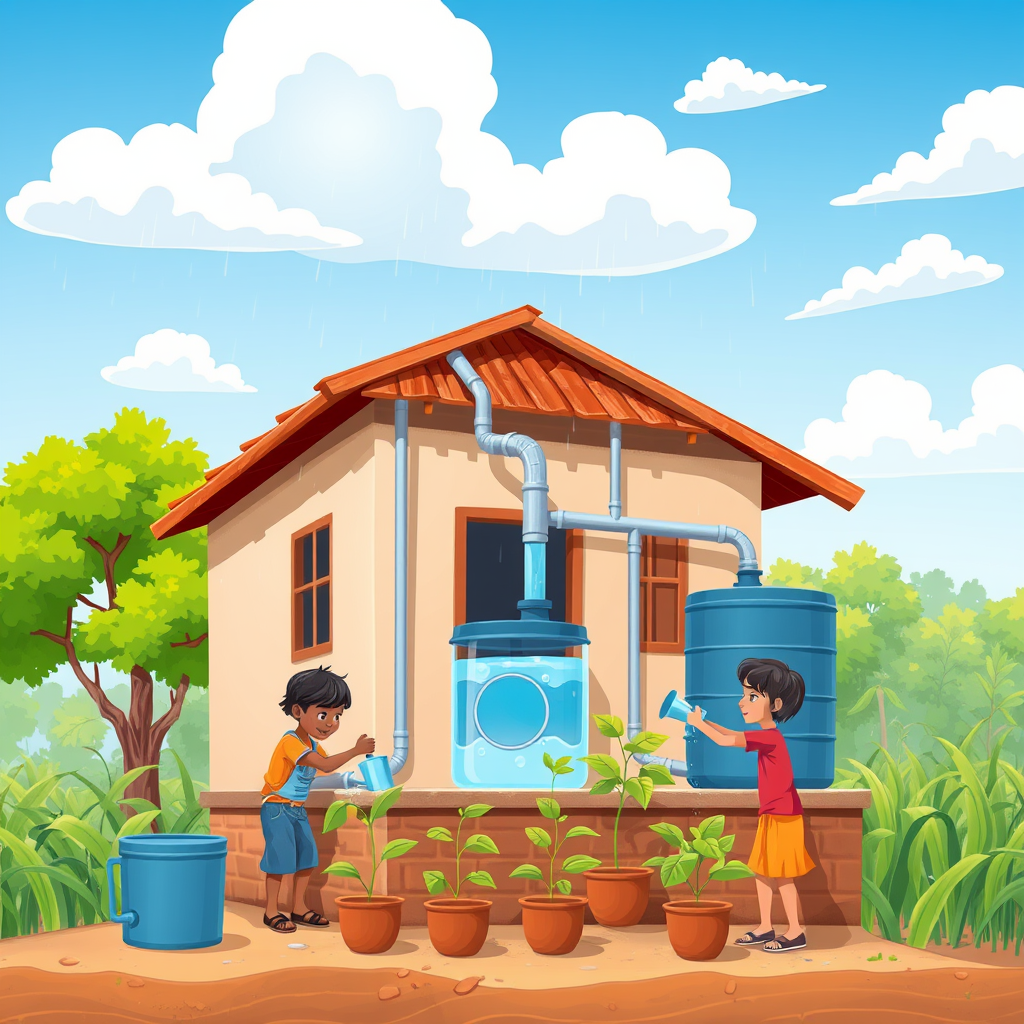
Rainwater harvesting is the technique of collecting and storing rainwater from rooftops, surface catchments, or artificially recharging groundwater aquifers. It is one of the oldest and most effective methods of water conservation, especially in regions with seasonal rainfall.
4.2 Techniques of Rainwater Harvesting
4.3 Importance of Rainwater Harvesting
- Groundwater Recharge: Harvesting replenishes depleting aquifers, raising the water table.
- Reduces Urban Flooding: By capturing runoff, it reduces the burden on stormwater drainage systems.
- Improves Water Quality: Rainwater is naturally soft and free from dissolved salts and chemicals.
- Cost-Effective: Rooftop harvesting systems are relatively inexpensive and require low maintenance.
- Reduces Dependency: Harvesting reduces reliance on municipal water supplies and deep tube-wells.
🏺 5. Traditional Water Harvesting Systems of India
5.1 Regional Diversity in Water Harvesting
India has a rich heritage of traditional water harvesting systems, adapted to local geography and climate. Each region developed its own unique method over centuries.
⚖️ 6. Water Conflicts & Management
6.1 Major Water Disputes in India
- Cauvery Water Dispute: Between Karnataka and Tamil Nadu — one of India’s longest-running river disputes, dating back to 1892. The Cauvery Water Disputes Tribunal (CWDT) award in 2007 allocated 419 TMC ft to Tamil Nadu and 270 TMC ft to Karnataka.
- Krishna-Godavari Dispute: Between Maharashtra, Karnataka, Andhra Pradesh, and Telangana over the sharing of Krishna and Godavari waters.
- Narmada Water Dispute: Between Gujarat, Madhya Pradesh, Maharashtra, and Rajasthan, resolved by the Narmada Water Disputes Tribunal in 1979. The Sardar Sarovar Project is its most visible manifestation.
- Ravi-Beas Dispute: Between Punjab and Haryana over the sharing of these tributary waters.
6.2 Water Conservation Strategies for the Future
- Watershed Management: Integrated development of land, water, and vegetation in a catchment area to prevent soil erosion and maximize water retention.
- Drip Irrigation & Sprinklers: Micro-irrigation methods that reduce water usage by 40-70% compared to traditional flood irrigation.
- Interlinking of Rivers (ILR) Project: A proposed network of canals to transfer water from surplus to deficit basins. Highly controversial due to ecological concerns.
- Water Recycling & Reuse: Treating wastewater for industrial and agricultural use reduces pressure on freshwater sources.
- Community-Based Water Management: Involving local communities in managing water resources through water users’ associations has proven highly effective in Gujarat and Maharashtra.
- Rainwater Harvesting Mandates: Several states (Tamil Nadu was the first, in 2003) have made RWH mandatory for all new buildings.
📘 Key Fact: Tamil Nadu became the first Indian state to make rainwater harvesting compulsory for every building in 2003. This significantly improved Chennai’s groundwater levels within just 3-4 years.
📋 7. Previous Year Questions (2017–2026)
❓ 8. Frequently Asked Questions
Q1. Why is water scarcity a growing concern in India?
Water scarcity in India is growing due to rapid population growth, over-exploitation of groundwater, pollution of rivers and lakes, climate change affecting rainfall patterns, and wasteful agricultural practices. Despite adequate average rainfall, the uneven seasonal and regional distribution creates acute shortages.
Q2. What are the main differences between a dam and a check dam?
A dam is a large structure built across a river for multipurpose use (irrigation, hydroelectricity, flood control), while a check dam is a small, temporary barrier built across small streams or gullies to slow water flow and recharge groundwater. Check dams are eco-friendly, inexpensive, and do not displace people.
Q3. How does rainwater harvesting help in groundwater recharge?
Rainwater harvesting directs captured rainwater into recharge pits, trenches, or old wells, allowing water to percolate through soil layers and replenish underground aquifers. This raises the water table, improves water quality through natural filtration, and ensures year-round water availability.
Q4. What is the bamboo drip irrigation system of Meghalaya?
It is a 200-year-old traditional irrigation system practised by the Khasi and Jaintia tribes of Meghalaya. Bamboo pipes of varying diameters channel spring water from hill streams to betel leaf plantations. The water drips at a rate of 20-80 drops per minute, efficiently irrigating plants without wastage.
Q5. What is the Cauvery Water Dispute about?
The Cauvery Water Dispute is a long-standing conflict between Karnataka and Tamil Nadu over the sharing of Cauvery River waters. Karnataka, as the upstream state, wants more water for its growing agricultural and industrial needs, while Tamil Nadu relies on the river for the delta region’s extensive paddy cultivation. The dispute dates back to 1892 colonial agreements.
Q6. How are traditional water harvesting systems different from modern dams?
Traditional systems (Khadin, Johad, Kulhs, Tankas) are small-scale, locally managed, low-cost, and environmentally sustainable. Modern dams are large-scale, capital-intensive, displace communities, and have significant ecological impacts. Traditional methods focus on decentralized groundwater recharge, while dams focus on surface water storage.
Q7. Which is the highest dam in India?
Tehri Dam on the Bhagirathi River in Uttarakhand is the highest dam in India at 260.5 metres. It is also one of the tallest dams in the world and generates 1,000 MW of hydroelectricity while irrigating 2,70,000 hectares.
Q8. What is watershed management?
Watershed management is the integrated development of land, water, and vegetation resources in a catchment area. It involves soil conservation, afforestation, rainwater harvesting, and check dam construction to maximize water retention and minimize soil erosion. It is considered a sustainable solution to India’s water problems.
Q9. Why did Jawaharlal Nehru call dams the “temples of modern India”?
Nehru envisioned large dams as symbols of India’s development and modernization — providing irrigation for food security, electricity for industries, and water for growing cities. He believed dams would transform India’s agricultural economy and improve millions of lives, just as temples are centres of spiritual upliftment.
Q10. What steps has the Indian government taken to address water scarcity?
Key initiatives include: Jal Jeevan Mission (piped water to every rural household by 2024), Atal Bhujal Yojana (groundwater management), National Mission for Clean Ganga (river rejuvenation), Pradhan Mantri Krishi Sinchayee Yojana (micro-irrigation promotion), interlinking of rivers project, and rainwater harvesting mandates in urban building bye-laws.
Q11. Explain the Khadin system of Rajasthan.
The Khadin system is a traditional floodwater harvesting technique practised in the arid regions of Rajasthan. Long earthen embankments (bunds) are built across gentle slopes to capture monsoon rainwater. The water spreads over the agricultural fields, allowing crops to grow even in dry areas with very low rainfall (100-500 mm annually).
Q12. How does the interlinking of rivers project aim to solve water problems?
The National River Linking Project (NRLP) proposes 30 links between 37 rivers across India to transfer water from surplus to deficit basins. Its goals include: adding 35 million hectares of irrigation capacity, generating 34,000 MW of hydroelectricity, and mitigating floods and droughts. However, critics cite massive ecological disruption, displacement of communities, and cross-state political disagreements.