MP Board Class 10 Science Chapter 13: Our Environment —
MP Board Class 10 Science Chapter 13: Our Environment (हमारा पर्यावरण) — This chapter explains the interactions between living organisms and their surroundings, food chains and food webs, trophic levels, biological magnification, ozone layer depletion, and waste management. With a weightage of 6–8 marks in the MP Board Class 10 Science exam (2027), this chapter is a scoring topic that combines theoretical concepts with real-world environmental issues. This comprehensive guide covers all NCERT-based topics, previous year questions, solved examples, and FAQs to help you master the chapter.
📑 Table of Contents
- 1. Ecosystem — Structure and Function
- 2. Food Chains and Food Webs
- 3. Trophic Levels and Energy Flow
- 4. Biological Magnification
- 5. Ozone Layer and Its Depletion
- 6. Managing the Garbage We Produce
- 7. Key Differences and Comparisons
- 8. Previous Year Questions (2017–2026)
- 9. Frequently Asked Questions
🌍 1. Ecosystem — Structure and Function
What is an Ecosystem?
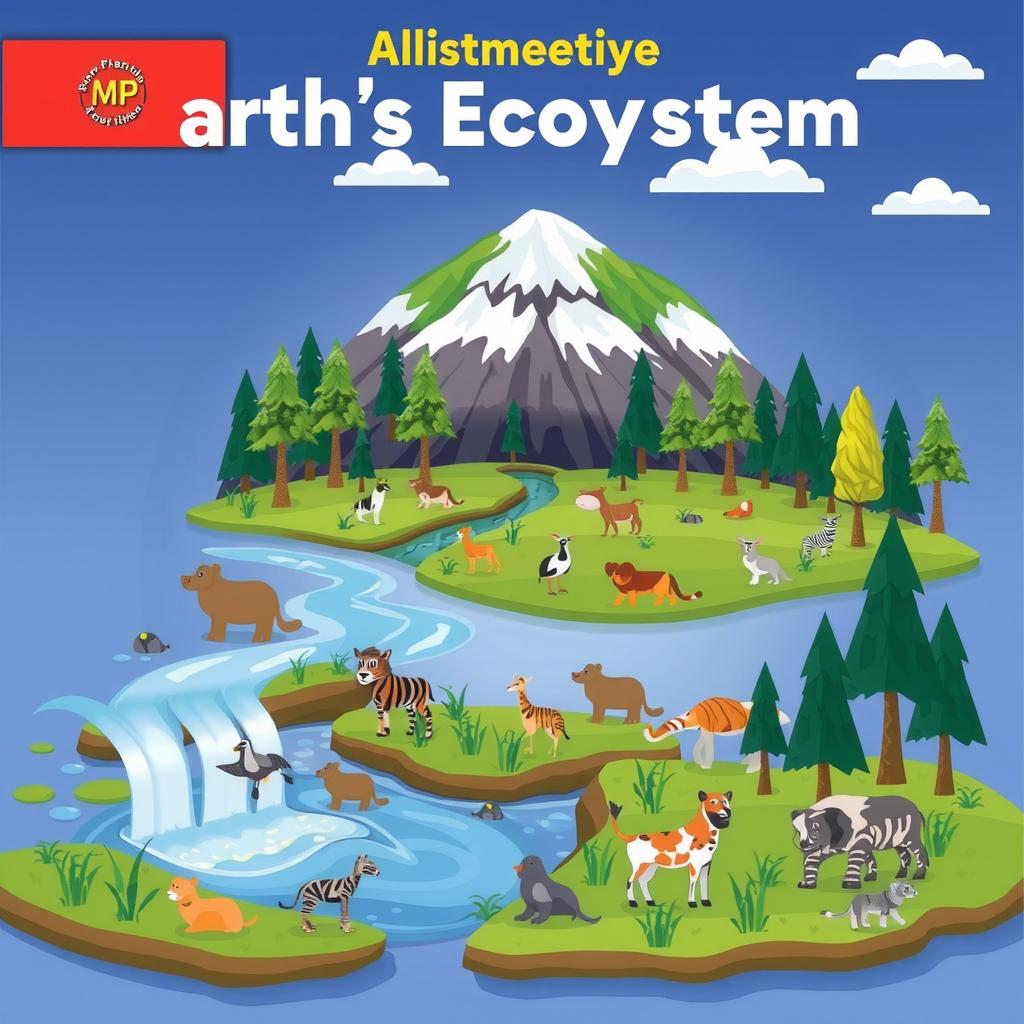
An ecosystem is a self-sustaining unit comprising all living organisms (biotic components) and their non-living (abiotic components) environment interacting with each other. The term ‘ecosystem’ was coined by A.G. Tansley (1935). Ecosystems can be natural or artificial, and they range in size from a small pond to a vast forest.
Types of Ecosystems
🍃 2. Food Chains and Food Webs
Food Chain
A food chain is a linear sequence of organisms through which energy and nutrients pass as one organism eats another. Each step in the food chain represents a trophic level. The first trophic level (T1) consists of producers, followed by primary consumers (herbivores), secondary consumers (small carnivores), and tertiary consumers (top carnivores).
Example of a grassland food chain:
Grass (Producer) → Grasshopper (Primary Consumer) → Frog (Secondary Consumer) → Snake (Tertiary Consumer) → Eagle (Quaternary Consumer)
Example of a pond ecosystem food chain:
Phytoplankton → Zooplankton → Small Fish → Large Fish → Kingfisher
Food Web
A food web is a network of interconnected food chains in an ecosystem. In nature, organisms rarely eat only one type of food — a single organism can occupy different trophic levels depending on what it consumes. A food web provides a more realistic representation of the feeding relationships in an ecosystem compared to a simple food chain.
⚡ 3. Trophic Levels and Energy Flow
10% Law of Energy Transfer
The 10% Law, proposed by Lindeman (1942), states that only about 10% of the energy available at one trophic level is transferred to the next trophic level. The remaining 90% is used for metabolic processes (respiration, growth, reproduction) or lost as heat to the environment.
📘 Energy Flow Calculation:
If 10,000 J of solar energy is captured by plants (Producers, T1):
→ T2 (Herbivores): 1,000 J (10% of 10,000)
→ T3 (Small Carnivores): 100 J (10% of 1,000)
→ T4 (Large Carnivores): 10 J (10% of 100)
→ T5 (Top Carnivores): 1 J (10% of 10)
Trophic Levels in an Ecosystem
Ecological Pyramids
An ecological pyramid is a graphical representation of the relationship between organisms at different trophic levels. There are three types:
- Pyramid of Numbers — Shows the number of organisms at each trophic level. Upright in most ecosystems (many producers, few top consumers). Inverted in tree ecosystems (one tree → many insects → few birds).
- Pyramid of Biomass — Shows the total biomass (dry weight) at each trophic level. Upright in terrestrial ecosystems; inverted in aquatic ecosystems (phytoplankton biomass < zooplankton biomass).
- Pyramid of Energy — Shows the amount of energy available at each trophic level. Always upright because energy always decreases at each successive trophic level due to the 10% Law.
⚠️ 4. Biological Magnification
What is Biological Magnification?
Biological magnification (also called biomagnification) is the progressive increase in the concentration of harmful chemical substances (like pesticides, heavy metals) at each successive trophic level in a food chain. These chemicals are non-biodegradable and persist in the environment for a long time.
Classic example — DDT Accumulation:
Farmers spray DDT (a pesticide) on crops → DDT enters water bodies through runoff → Phytoplankton absorb small amounts of DDT → Zooplankton consume phytoplankton → Small fish eat zooplankton → Large fish eat small fish → Birds (like eagles and falcons) eat large fish. At each step, DDT concentration increases approximately 10 times. This is why DDT was banned in most countries — it caused thinning of eggshells in predatory birds.
Water: 0.000003 ppm → Phytoplankton: 0.04 ppm → Zooplankton: 0.5 ppm → Small Fish: 2 ppm → Large Fish: 10 ppm → Fish-eating Birds: 25 ppm
🛡️ 5. Ozone Layer and Its Depletion
What is Ozone?
Ozone (O₃) is a molecule made of three oxygen atoms. The ozone layer is a region of the Earth’s stratosphere that contains a high concentration of ozone, located approximately 20–30 km above the Earth’s surface. It acts as a protective shield that absorbs 97–99% of the Sun’s harmful ultraviolet (UV) radiation.
How Ozone is Formed and Destroyed
📘 Ozone Formation (Natural):
UV radiation splits an oxygen molecule (O₂) into two oxygen atoms (O + O). Each oxygen atom (O) then combines with another oxygen molecule (O₂) to form ozone (O₃).
O₂ + UV → O + O
O + O₂ → O₃
Causes of Ozone Depletion
The primary cause of ozone depletion is the release of Chlorofluorocarbons (CFCs) — chemicals used in refrigerators, air conditioners, aerosol sprays, and foam-blowing agents. CFCs rise to the stratosphere where UV radiation breaks them down, releasing chlorine atoms. Each chlorine atom can destroy up to 100,000 ozone molecules through a catalytic cycle.
Effects of Ozone Depletion
- Human Health: Increased UV-B radiation causes skin cancer, cataracts, sunburns, and weakened immune system.
- Plants: Reduced photosynthesis, stunted growth, lower crop yields, damage to leaf tissues.
- Marine Life: Damage to phytoplankton (the base of aquatic food chains), reduced fish populations.
- Materials: Accelerated degradation of plastics, paints, and building materials.
♻️ 6. Managing the Garbage We Produce
Types of Waste
Waste can be categorized as biodegradable and non-biodegradable:
Waste Management Practices
- Reduce: Minimise the use of non-biodegradable products. Use cloth bags instead of plastic bags, buy products with minimal packaging.
- Reuse: Reuse items wherever possible — glass bottles, containers, old newspapers for wrapping, rechargeable batteries.
- Recycle: Convert waste materials into new products — recycling paper saves 70% energy compared to making new paper; recycling aluminium saves 95% energy.
- Composting: Convert biodegradable kitchen and garden waste into nutrient-rich compost for plants.
- Segregation: Separate waste into biodegradable and non-biodegradable at the source. Use separate bins (green for biodegradable, blue for non-biodegradable).
📘 3R Principle Simplified:
Reduce → Use less. Reuse → Use again. Recycle → Make new from old. The 3Rs are arranged in order of environmental preference — reducing waste at the source is always better than recycling it later.
📊 7. Key Differences and Comparisons
Biodegradable vs Non-biodegradable Wastes
Autotrophs vs Heterotrophs
📋 Previous Year Questions (2017–2026)
❓ Frequently Asked Questions
Q1. What is an ecosystem? What are its components?
An ecosystem is a self-sustaining system where living organisms interact with each other and with their non-living environment. Its components include biotic (producers, consumers, decomposers) and abiotic (sunlight, temperature, water, soil, air, minerals) factors.
Q2. What is the difference between a food chain and a food web?
A food chain is a linear sequence of energy transfer, while a food web is a network of interconnected food chains. Food webs are more stable because organisms have alternative food sources if one is affected.
Q3. State the 10% Law of energy transfer.
Only 10% of the energy available at one trophic level is transferred to the next trophic level. The remaining 90% is used for respiration, growth, reproduction, and lost as heat.
Q4. What is biological magnification? Give an example.
Biological magnification is the increase in concentration of harmful chemicals (like DDT, mercury) at each successive trophic level. For example: Water (0.000003 ppm DDT) → Phytoplankton (0.04 ppm) → Zooplankton (0.5 ppm) → Small fish (2 ppm) → Large fish (10 ppm) → Fish-eating birds (25 ppm).
Q5. What is the ozone layer? Why is it important?
The ozone layer is a protective layer of ozone (O₃) gas in the stratosphere (20–30 km above Earth). It absorbs 97–99% of the Sun’s harmful UV-B radiation, preventing skin cancer, cataracts, and damage to plants and marine life.
Q6. What are CFCs and how do they cause ozone depletion?
CFCs (Chlorofluorocarbons) are chemicals used in refrigerators, ACs, and aerosol sprays. When they reach the stratosphere, UV radiation breaks them down, releasing chlorine atoms. Each chlorine atom can destroy up to 100,000 ozone molecules.
Q7. What is the Montreal Protocol?
The Montreal Protocol (1987) is an international treaty designed to phase out the production and use of ozone-depleting substances like CFCs. It is one of the most successful environmental treaties, with universal ratification by all UN member countries.
Q8. Differentiate between biodegradable and non-biodegradable substances.
Biodegradable substances (e.g., paper, wood, food waste) can be broken down by microorganisms into simpler substances. Non-biodegradable substances (e.g., plastic, glass, DDT) cannot be broken down naturally and persist in the environment for long periods.
Q9. What is the 3R principle in waste management?
The 3Rs are: Reduce (minimise waste generation), Reuse (use items again instead of discarding), and Recycle (convert waste into new products). They are arranged in order of environmental preference — reduction is the most effective.
Q10. Why are green plants called producers?
Green plants are called producers because they can produce their own food through photosynthesis using sunlight, carbon dioxide, and water. They convert solar energy into chemical energy (food), which forms the basis of all food chains.
Q11. What would happen if all decomposers are removed from an ecosystem?
If decomposers are removed, dead bodies and waste would accumulate, nutrients would not be recycled back into the soil, and the ecosystem would collapse due to lack of nutrients for producers.
Q12. Why is the pyramid of energy always upright?
The pyramid of energy is always upright because energy always decreases at each successive trophic level due to the 10% Law (energy is lost as heat through metabolic processes at each level).