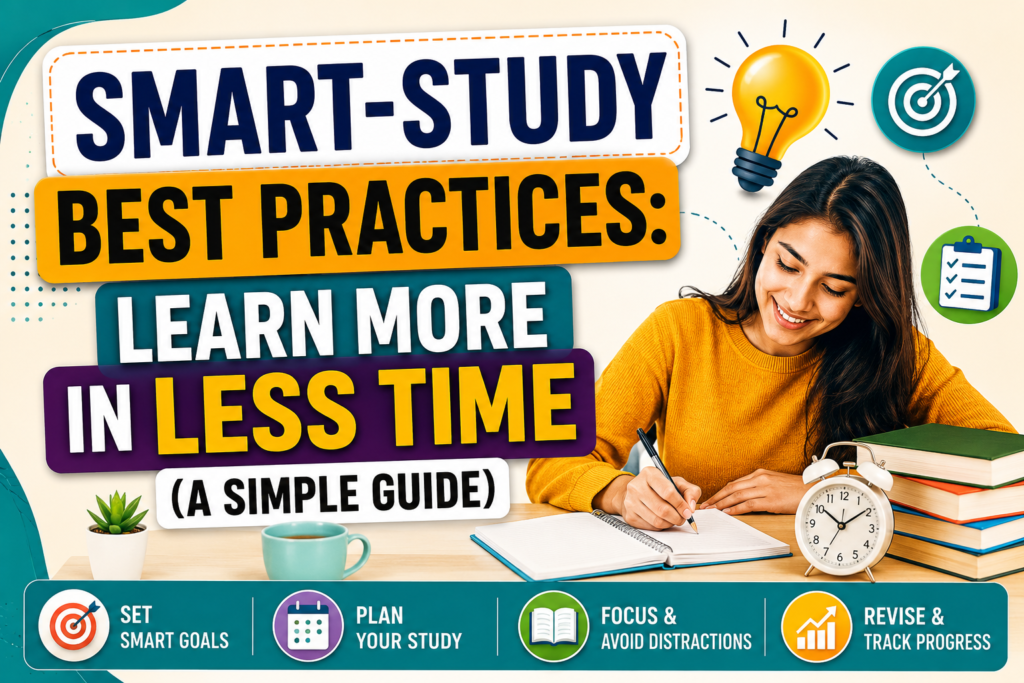
Smart-Study Best Practices: Learn More in Less Time (A Si…
Smart-Study Best Practices: Learn More in Less Time (A Simple Guide)
Have you ever studied for hours but still felt like nothing went into your brain? You are not alone. Many students in India spend 6 to 8 hours daily on books but forget most of it the next day. That is not smart studying. That is just hard work with little reward.
Smart-study best practices are simple techniques that help you learn faster and remember longer. They are not about magic tricks. They are about using how your brain naturally works. In this guide, you will discover 8 proven methods to cut your study time by half while getting better marks. No jargon. Just clear, practical steps you can start using today.
Table of Contents
- What is Smart-Study? (And Why It Matters)
- Active Recall: The Brain’s Best Friend
- Spaced Repetition: Review at the Right Time
- Pomodoro Technique: Short Bursts, Big Results
- Feynman Technique: Teach to Learn
- Interleaving: Mix It Up
- Your Study Environment: Small Changes, Big Impact
- Sleep and Nutrition: The Secret Weapons
- Key Takeaways
- What This Means For You
- Frequently Asked Questions
- Conclusion
What is Smart-Study? (And Why It Matters)
Smart-study means using your time and energy in the most effective way possible. It is not about studying more hours. It is about studying better. Think of it this way: two students can sit for the same 3 hours. One reads the textbook over and over. The other uses smart techniques. Who do you think will score higher? The second student, almost every time.
Research from cognitive science (the study of how the brain learns) shows that most traditional methods — like re-reading notes or highlighting — are almost useless. A 2013 study by Dunlosky and colleagues found that re-reading gives very little improvement in long-term memory. Yet it is the most common method used by students. Smart-study best practices flip this around. They focus on actively pulling information out of your brain, not just putting it in.
Here is a simple truth: your brain is like a muscle. If you just watch someone lift weights, you will not get stronger. You have to lift the weight yourself. Studying works the same way. Reading a chapter is like watching. Answering questions without looking is like lifting. That is the core of smart studying.
Active Recall: The Brain’s Best Friend
Active recall is the single most powerful smart-study technique. It means forcing your brain to retrieve information from memory without looking at the book. For example, after reading a page, close the book and try to say out loud what you just learned. This simple act strengthens the neural pathways (connections between brain cells) in your brain.
Why does this work? When you retrieve information, your brain has to work harder. This effort signals to your brain: “This is important. Keep it.” Studies show that active recall can improve long-term memory by 50% or more compared to re-reading. A famous study by Karpicke and Roediger (2008) found that students who used active recall remembered 80% of material after a week, while those who only re-read remembered just 30%.
How to Use Active Recall
- Close the book after every section: Read one paragraph. Close the book. Say the key point in your own words. Then move on.
- Use flashcards: Write a question on one side, answer on the other. Test yourself daily. Apps like Anki are free and excellent.
- Teach someone else: Explain a concept to a friend or family member. If you cannot explain it simply, you do not understand it yet.
- Write from memory: After studying a topic, write down everything you remember on a blank sheet of paper. Then check what you missed.
The key is to avoid looking at the answer until you have tried your best. Even if you get it wrong, the attempt helps your brain learn.
Spaced Repetition: Review at the Right Time
Spaced repetition is the idea of reviewing information at increasing intervals over time. Instead of cramming everything the night before an exam, you spread out your study sessions. For example, review a topic after 1 day, then after 3 days, then after 1 week, then after 1 month. Each review strengthens the memory just as it is about to fade.
This technique is based on the “forgetting curve” discovered by German psychologist Hermann Ebbinghaus in the 1880s. He found that we forget information very quickly — within hours — unless we actively review it. But each review slows down the forgetting. After a few spaced reviews, the memory becomes almost permanent.
How to Apply Spaced Repetition
- Use a calendar or app: Mark days for review. Apps like Anki or Quizlet do this automatically for you.
- Create a revision schedule: For a test in 30 days, study the topic today. Review it on Day 2, Day 5, Day 12, and Day 25.
- Never cram: Cramming works for the next morning but fails in the long run. For board exams or competitive exams like JEE or NEET, spaced repetition is your best friend.
Think of it like watering a plant. One big bucket of water once a month does not help. Small, regular waterings keep the plant healthy. Spaced repetition is the same for your memory.
Pomodoro Technique: Short Bursts, Big Results
The Pomodoro Technique is a time management method developed by Francesco Cirillo in the late 1980s. It is simple: work for 25 minutes, then take a 5-minute break. After four such cycles (called “pomodoros”), take a longer break of 15–30 minutes. The name comes from a tomato-shaped kitchen timer (pomodoro means tomato in Italian) that Cirillo used as a student.
This technique works because it matches how your brain naturally focuses. Most people can only maintain deep concentration for about 20–30 minutes. After that, attention drops sharply. By taking short breaks, you reset your focus. You also avoid burnout — that exhausted feeling after studying for hours straight.
How to Use the Pomodoro Technique for Smart-Study
- Pick one task to study. No multitasking.
- Set a timer for 25 minutes. Work only on that task.
- When the timer rings, take a 5-minute break. Stretch, drink water, or walk around. Do not use your phone — it can overstimulate your brain.
- After four pomodoros, take a longer break of 15–30 minutes.
- Repeat as needed.
Many students find that they complete more in three focused 25-minute sessions than in two hours of distracted reading. Try it for one day and see the difference yourself.
Feynman Technique: Teach to Learn
The Feynman Technique is named after Richard Feynman, a Nobel Prize-winning physicist known for explaining complex ideas in simple language. The technique is straightforward: if you cannot explain a concept in plain, simple words, you do not truly understand it. The goal is to break down complicated topics until a child could grasp them.
Steps to Use the Feynman Technique
- Choose a concept: Pick something you want to learn, like photosynthesis or the Pythagorean theorem.
- Explain it to yourself: Pretend you are teaching it to a 10-year-old. Use everyday words. No jargon. Write it down or say it aloud.
- Identify gaps: Wherever you get stuck or use complicated terms, that is a gap in your understanding. Go back to your book or notes and fill that gap.
- Simplify and repeat: Rewrite the explanation using even simpler language. Keep going until it flows naturally.
This technique is excellent for subjects like science, mathematics, and history. It forces you to think deeply rather than memorizing facts by rote (repeating without understanding).
Interleaving: Mix It Up
Interleaving means mixing different topics or types of problems in a single study session. Instead of studying only one chapter of math for two hours, you study a bit of algebra, then geometry, then algebra again. This might feel harder at first. That is the point. The difficulty forces your brain to work harder, which strengthens learning.
Most students prefer “blocked practice” — doing the same type of problem over and over. For example, solving 20 quadratic equations in a row. This feels productive because you get every answer right. But research shows that blocked practice leads to shallow learning. You learn the procedure, not the concept. In an exam, when problems are mixed, blocked practice students often fail.
How to Interleave
- Mix subjects: Study 20 minutes of physics, then 20 minutes of chemistry, then 20 minutes of biology.
- Mix problem types: In math, do a few problems from chapter 3, then chapter 5, then chapter 2.
- Use random order: Do not follow the textbook order. Use a shuffled list of topics.
A study by Rohrer and Taylor (2007) found that students who interleaved math problems scored 43% higher on a test one week later, compared to those who used blocked practice. The initial struggle is worth it.
Your Study Environment: Small Changes, Big Impact
Your surroundings affect how well you study. A messy, noisy, or distracting environment makes it very hard to focus. Smart-study best practices include optimizing your study space. You do not need a fancy room. Just a few simple changes can make a huge difference.
Key Elements of a Good Study Environment
- Lighting: Natural light is best. If studying at night, use a bright white light. Dim yellow lights make you sleepy.
- Noise: Silence is ideal for deep work. If you cannot get silence, use white noise apps or instrumental music. Avoid songs with lyrics — they distract your brain.
- Clutter: Keep only what you need on your desk: books, notebook, pen, water. Remove your phone or put it in another room.
- Temperature: A cool room (around 20–22°C) is best for focus. Warm rooms make you drowsy.
- Chair and posture: Sit upright on a chair. Do not study on your bed — your brain associates bed with sleep.
One small trick: before starting, clean your desk for 2 minutes. This signals to your brain: “It is study time now.” It is a simple ritual that builds focus.
Sleep and Nutrition: The Secret Weapons
Many students think that sacrificing sleep for extra study hours is smart. It is not. Sleep is when your brain processes and stores what you learned during the day. Without enough sleep, your memory actually gets worse. A study from Harvard Medical School found that students who slept well after studying remembered 20–30% more than those who stayed awake.
Sleep Tips for Smart Study
- Aim for 7–9 hours: Teenagers and young adults need this much. Less than 6 hours hurts your ability to learn new things.
- Study before sleep: Reviewing key points just before bed helps your brain consolidate (lock in) that memory.
- No screens 30 minutes before bed: Blue light from phones and laptops tricks your brain into thinking it is daytime, making it harder to fall asleep.
Nutrition for Better Focus
- Eat a balanced meal: Include protein (eggs, dal, paneer), healthy fats (nuts, avocado), and complex carbs (oats, brown rice).
- Stay hydrated: Even mild dehydration can reduce concentration. Keep a water bottle on your desk.
- Avoid sugar crashes: Sugary snacks give a quick energy spike, then a crash. Choose nuts, fruits, or yogurt instead.
Think of your brain as a high-performance car. Would you put low-quality fuel in it? No. Your food and sleep are the fuel for studying.
Key Takeaways
- Active recall — testing yourself without looking — is the most effective study technique, improving memory by up to 50%.
- Spaced repetition means reviewing at increasing intervals; it beats cramming for long-term learning.
- The Pomodoro Technique (25 minutes work, 5 minutes break) prevents burnout and keeps focus high.
- The Feynman Technique — explaining a concept in simple words — reveals gaps in your understanding.
- Interleaving (mixing topics) feels harder but leads to much better exam performance.
- A clean, quiet, well-lit study space with no phone distractions boosts concentration significantly.
- Sleep of 7–9 hours is essential for memory consolidation; never trade sleep for extra study hours.
- Good nutrition and hydration directly affect your brain’s ability to learn and focus.
What This Means For You
You might be thinking: “This sounds great, but I have exams in two weeks. Can I still use these methods?” Absolutely. Even if you start today, you will see a difference. Here is what you should do right now:
First, pick just one technique — active recall. For the next week, after every study session, close your book and test yourself. Write down what you remember. That one change will improve your retention more than any other single thing. Second, set a timer for 25 minutes and work without any distractions. No phone, no social media. Just pure focus. You will be surprised how much you get done.
Third, stop studying after 10 PM. Instead, review your key points for 10 minutes and go to bed. Your brain will do the rest of the work while you sleep. Remember, smart-study is not about being a genius. It is about using simple, science-backed methods to get the most out of your time. Start small. Be consistent. The results will follow.
Frequently Asked Questions
1. What is the single most effective smart-study technique?
Active recall is widely considered the most effective. It means testing yourself without looking at the material. For example, after reading a page, close the book and try to say or write the main points. Research by Karpicke and Roediger (2008) showed that active recall improves long-term memory far more than re-reading or highlighting. It forces your brain to work hard, which strengthens the memory.
However, active recall works best when combined with spaced repetition. Use flashcards or a schedule to review the same material at increasing intervals. Together, these two techniques form the foundation of smart studying.
2. How much time should I study each day using smart methods?
Quality matters more than quantity. With smart-study techniques, 3–4 hours of focused, active studying can be more effective than 8 hours of passive reading. Use the Pomodoro Technique: 25 minutes of deep work followed by a 5-minute break. After four cycles, take a longer break. This keeps your brain fresh.
For most students, 4–6 pomodoros (about 2–3 hours of actual study time) per day is a good target. Adjust based on your energy and schedule. The key is to stop when you feel your concentration dropping. Forcing yourself to study when tired is counterproductive.
3. Can smart-study techniques help for competitive exams like JEE or NEET?
Yes, absolutely. These exams test deep understanding and long-term memory, not last-minute cramming. Spaced repetition and interleaving are especially useful. For JEE, you need to solve problems from physics, chemistry, and math. Interleaving — mixing problem types — trains your brain to choose the right approach for each problem, just like in the actual exam.
Many top rankers use active recall and flashcards. They do not just read. They constantly test themselves. Start using these techniques early in your preparation, not just a month before the exam.
4. How do I avoid forgetting what I studied after a few days?
Forgetting is natural. Your brain clears out information it thinks is not important. To stop this, use spaced repetition. Review the material after 1 day, then 3 days, then 1 week, then 1 month. Each review tells your brain: “This is important. Keep it.”
Also, connect new information to things you already know. For example, if you are learning about the heart, connect it to how your own heart beats. Making personal connections strengthens memory. Finally, teach the concept to someone else. Teaching forces you to organize your thoughts clearly.
5. Is it better to study one subject for hours or switch between subjects?
Switching between subjects — called interleaving — is usually better for long-term learning. It might feel harder at first, but that difficulty is good for your brain. A study by Rohrer and Taylor (2007) found that students who mixed math problems scored much higher on a test one week later.
However, for very complex topics, you might need a longer block of time to understand the basics. A good rule is: study one topic for 45–60 minutes, then switch to a different subject. Do not switch every 10 minutes. That is just distraction.
6. How can I stay focused while studying at home?
Home can be full of distractions. The first step is to create a dedicated study space. Keep it clean and free of your phone. Use the Pomodoro Technique to build focus in short bursts. Before each session, write down exactly what you will study. This gives your brain a clear target.
If you live in a noisy household, use noise-cancelling headphones or play white noise (like rain sounds). Inform your family about your study timings so they do not disturb you. Finally, use a “distraction list”: whenever an unrelated thought pops up, write it